
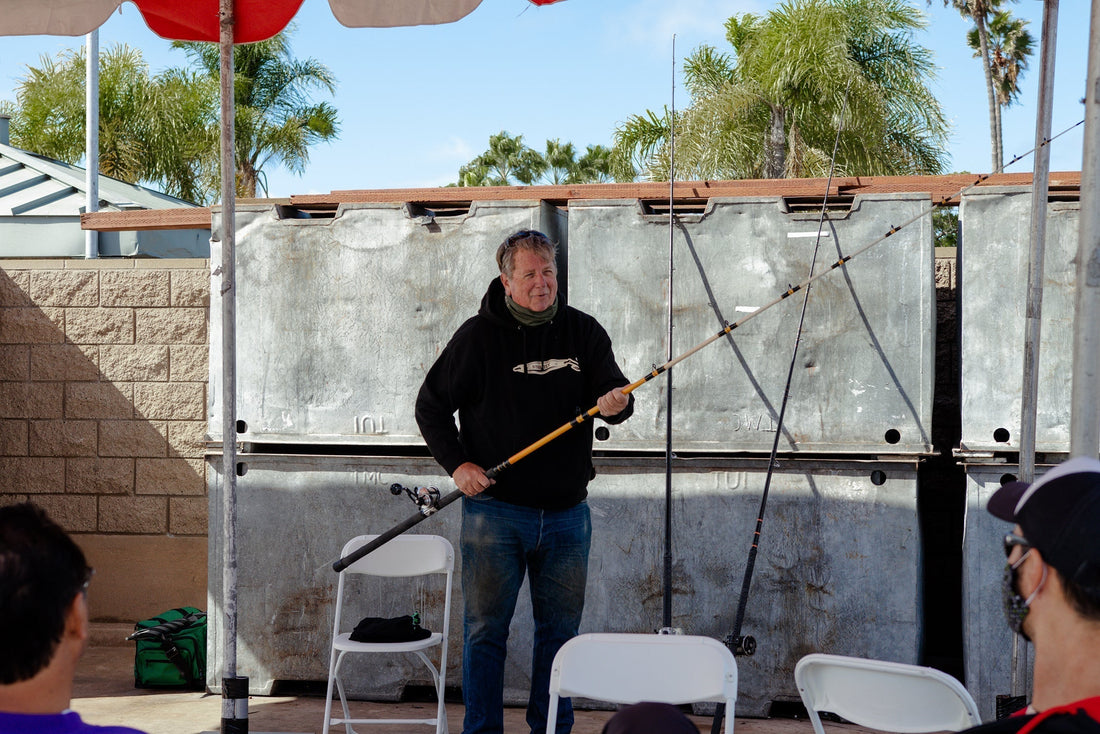

Background - dan wade
Dan Wade is a veteran jig fisherman who is known for his surface iron knowledge. With more than 50 years of experience, this is the guy you want to talk to when it comes to jig fishing.
Hey peeps! Before we dive deep into Dan Wade's seminar and all of his thought process behind surface iron fishing, I want to take a moment to thank you for your overwhelming support over the past 5 years! Strictly Irons started in 2015 with the goal of representing our local jig fishermen and is slowly growing into an educational platform where we can help each other grow. Once again, thank you for your support and for taking the time to read this article!
If you found this blog educational please share it with your friends! If you have any questions or want to share your knowledge with us, send us an e-mail at info@strictlyirons.com or send us a message on Instagram!
Alright, let’s get started!
JIG STICKS - The Importance of 9-10' Rods

Dan began his seminar at Tackle Day talking about his tackle, specifically his rods of choice, also known as jig sticks. Someone asked him the following question, “What rods do you recommend fishing?” he answered, “The rod is what works for you. As long as it is 9-10 feet in length.” Dan had 3 of his favorite rods with him, a Harnell 724, Harnell 542, and a Seeker Skinny Butt Ulua, all measuring 10’.
One thing to note here is that all of his rods are Fiberglass and that is the only type of rod he will fish. The reason behind this is that fiberglass rods have more memory, meaning they are more parabolic. The more parabolic the rod is the less effort you have to put into casting which allows you to get the most out of your cast. Since these rods are so parabolic, it is good to mention that these rods do not have a lot of pulling power. Dan recommends you hook the fish, wind through the bite, put your rod on the rail and crank them up, this will take a lot of tension off your back.
THE SURFACE IRON - What to look for

Tady, Candy bar, Salas, JRI, Steel Baits, Durans, OCT, Kicker, Dreadnought, the list goes on! With an overwhelming amount of surface irons to pick from you have to narrow it down to the type of fishing you will be doing and what the conditions are.
During his seminar, Dan stated a couple of things that I would love to share with you. Here are his pointers when it comes to picking out a surface iron and what iron to fish according to the conditions:
- Sharp edges are the number one thing to look for since this causes more water displacement.
- Everything starts at the nose of the jig.
- Fish a heavier surface iron when fishing the weather side of our local islands so the jig stays underwater. Example jigs include Salas 7X, JRI 4, OCT jig, Tady 45, Steel Baits, and more.
- Off-centered top hole: helps but doesn’t have to be.
According to Dan, the reasoning behind you wanting to have a jig that has an erratic swim with a kick is due to the following:
Bait schools swim in a ball and when a predatory fish approaches the school, it will go after the bait that moved out of the pack or “kicked out” of the school like a jig, this will cause the predatory fish to react and eat that bait.
COLOR: There is only one condition that Dan will consider the color of the jig and that is when it comes to fishing calico bass. His go-to color when fishing the kelp is a caterpillar yellow. As for Yellowtail, he will fish any color.
SIZE: When it comes to fishing the islands south of the border, Dan prefers to fish full-size jigs like Tady 45, Salas 7x, or JRI Stinger. On the other hand, our local fishery, La Jolla, is infamous for fish being keyed in on smaller jigs. Dan recommends fishing small jigs like a: Tady C, A1, DW1, J-POT, etc. If you have made several cast-at fish that aren't eating your full-sized jig, switch it up and tie on a small jig and see if that makes the difference.
Wiring a Surface Iron: "18-24 inches of 44# single strand wire with a haywire twist on both ends, one end has to have a connector ring which can be found at your local tackle shop. Fish wire on a candy bar 112 when there is little to no current."

BIG fish: When it comes to targeting big-grade yellowtail or bluefin tuna offshore, Dan suggests you fish 50# Line with a JRI 4, Tady 14A, and Salas 5x.
Changing out the hooks on the jig: There may be a handful of circumstances that may require you to change your hooks. The advice that Dan shared with us is to make sure it doesn't change the way the jig swims. If the past hook was a size 4/0 Treble hook, make sure you get the same size. A slight change in the weight of the hook can change the way the jig swims because it adds more drag to the back of the jig instead of allowing it to swim freely.
FISHING LINE - Monofilament and Braid

Monofilament line is by far one of the most popular types of lines when it comes to fishing surface irons. A line that Dan recommends to fish is 40-pound Izorline First String, another line that I would recommend is Triple X Izorline, both of these lines cast like butter! In addition to their amazing casting ability and strength, they are very affordable. You can find this line at your local tackle stores like Fisherman's Landing, Squidco, HM Landing, and more.
Here are a couple things Dan mentioned throughout his seminar on Monofilament line:
- Monofilament is very forgiving unlike braid.
- Yes, you will get backlashes but they happen to everyone.
- Observe your line throughout your day.
Braid/spectra are mostly used when fishing structures to avoid your line from getting snapped off. With that being said, Dan prefers to only fish braid if he is targeting yellowtail right along the kelp line so the braid can cut through the thick kelp. This is the only time he will ever fish braid on a surface iron.
In general, a monofilament line tends to jump out of your line so you can expect backlashes. Dan reminded us not to worry about backlashes or “bird’s nest” as some people call them, since it happens to the best of us, including himself.
Taking the time to observe your line every time you catch a fish is something we should all consider doing. If your line has a kink or has some type of rash on it, re-tie your jig, do not risk losing your good jig! It is better to take 20 seconds out of your day to re-tie a jig than to lose it.

Dan always brings a big spool of 40# First String with him on every trip just in case there is a kink in his line. If he spots one, he goes ahead and replaces his whole spool, up to where his backing is.
Backing up your spool: Fill up half of your spool with 40# mono or 65-80lb braid (personal preference) to be used as a backing, this way you will only have to change out 100 yards of 40# monofilament instead of replacing the entire spool! Save yourself some time and money by only changing out 100 yards of line instead of 200-300 yards.
SAN DIEGO JAM KNOT

By far, one of the most popular knots is the San Diego Jam knot. This is Dan's go-to knot when fishing jigs, something to note here is that it doesn't matter where the knot is tied on the ring. After plenty of casts, the knot will always end up at the weld.
REEL DRAG - Tight Drag, Rod on Rail

Attendee: “Hey Dan, how tight should my drag be set?”
Dan: “Very tight, you don’t lock it down but tight. The reason behind the tight drag is that the long rod is a shock absorber. You have to have a tight drag so the hooks come tight. If the drag isn’t tight enough the hooks will not set by themselves on the initial bite.”
Something else to add to this topic is to never set the hook! Always wind through the bite until some line comes off the reel and then they are hooked. Once they are hooked just place the rod on the rail and let the rod absorb the head shakes!
CASTING - Accuracy and Distance

EXPERIENCE AND PRACTICE IS THE KEY!
Casting is the first thing you need to learn to do before you get into surface iron fishing. Learning not only how to handle an open-faced reel but a 9-10 foot rod is a whole different scenario. As you hear in every sport, the main key to mastering a skill is... PRACTICE!
The more you cast the better you get. Get out to your local lake and make some cast or be like Dan and tie on some 3oz weights and practice casting in front of your house! Getting comfortable casting a 9-10’ rod is one thing, making a cast with a crowded bow and fish jumping out of the water is another. When fishing a cattle boat you are most likely not going to be the only one casting a jig from the bow. There may be up to 10 people on the bow and you have to be able to make accurate cast at boiling fish while people are running around behind you, making sure you don’t hook anybody. Sounds like a lot doesn’t it? That’s because it is! If you are a beginner I would recommend you get out on some half day boats and get comfortable with casting from the bow where you have people around you.
As Dan says, “Always make sure to look back, you aren’t going to miss the water.” Get comfortable making casts under pressure so when the time arrives, the last thing you are worrying about is making a bad cast.
Something else Dan mentioned, which is so true, is the fact that a lot of people tend to brag about how far they cast when it’s not about distance, it’s about accuracy. These fish can be anywhere from 10 yards to 100 yards off the boat but what’s a 100-yard cast if you aren't putting it right in front of the fish? It is best to observe what way the fish are moving, find a pattern, lock it down, and make that predicted cast right in front of their face.

Being on the bow of the boat watching fish blow up right in front of you makes your heart rate rise since you are so excited to make a cast and hook a fish! But the reality of what happens next when we see boiling fish is either a backlash or an inaccurate cast due to us losing our composure. Take a deep breath and focus on your cast so you can make the best out of that opportunity, it can be the only one you get all day. Learn to stay calm no matter how hectic the situation is.
With experience and spending time on the water, you will slowly begin to feel comfortable around a busy bow. Before you know it, you will notice that you are no longer worrying about minor things like a backlash and more focused on what is going around in your surroundings. For example, are the birds flying high or are they low? In what direction are the fish moving? What bait are the fish keyed on? How is the current in the water? How fast are you reeling in when you get a bite? Are the fish tight to the structure or away from it? These are all key points that you can be focusing on instead of focusing on your cast.
Budget Surface iron set up

Attendee: “What is a good budget reel?”
In today's market there are a variety of reels you can choose from, Dan recommends you stick with a star drag reel and any 20-40 sized spool reel.
For example Saltist 40, Torium 20-30, Penn Fathom 25n-40n, Trinidad 20-30a, Tern 300-500, and if you’re into classics you can get a Newell P332-F!
Something to note here that Dan did mention is the following: Spool size matters because the barrel of the reel shortens as you make a cast, therefore it messes with the gear ratio, which can affect the action of your jig.
Fun Fact: Penn Jig Master: A point Dan did not want to miss was the fact that the Penn Jig Master 4:1 was created specifically for fishing a jig, this is the reel every jig is based on.
CONFIDENCE - A SECRET KEY TO SUCCESS


Let’s talk about confidence! A key to getting bit:
Dan: “People get complacent. You have to change it up, get confident! People have confidence issues, they don't believe they're going to get a bite so they end up changing the jig right away. You have to have confidence in what you are doing.”
When I first started jig fishing this was one of my biggest problems, I was overwhelmed with the number of jigs in my tackle box and I didn’t know what to fish! I would tie one on, make about 5-10 casts with it and I would change it because I didn’t like the way it swam, this would happen all day so I would spend more time changing lures instead of fishing and observing what my jig was actually doing. I quickly started to realize that the jigs that “did not swim” was due to the fact that I wasn’t reeling slow or fast enough! Before you change your jig try experimenting with it: slow down/speed up your retrieve, try wiring the jig or you can try filing the edges with a cut file to make them sharper. Also, like Dan said, pick a jig according to the conditions.
Example: Wired Starman 112 when little to no current. JRI stinger when fishing current.
OBSERVING YOUR SURROUNDINGS - LOOK AT THE BIRDS!

Birds play a huge role when it comes to surface iron fishing, you should consistently be looking for them throughout the day and in between your casts.
Dan: "Look for terns NOT seagulls. The seagulls is where the fish were, the terns are where the fish are."
While seagulls are picking up the scraps, terns are chasing the fish. Observe the terns, see what they're looking at and heading to. "If terns are hovering 50' above the surface, the fish are 25' under. The closer they get to the water the higher the fish are higher in the water column." If the terns are staying high you can try making a cast and letting it sink a couple seconds and proceed with a consistent wind.
As Dan said in his final words, "Learn to read the fish, pay close attention to see how they are acting. Look for color spots in the water and keep an eye out for breezers and breaking fish. Once you see find them, look closely to figure out the direction they're moving in and make a cast right in front of them."
ADDITIONAL QUESTIONS ASKED BY ATTENDEES

"What do you do if you are getting followers but no takers?"
Dan: "Tie on different lures, speed it up, tie on wire. Switch it up."
"What do you think of CNC jigs?"
Dan: "I only use sand casted irons due to imperfections, the human mistake is the best, it's what makes the jig swim. Die-cast is all the same, just like a waxwing, same side-to-side action. The yellowtail will follow it all the way to the boat but won't bite it, you will have a lot of followers but no biters."
"How do you know if a jig will swim?"
Dan: "Pick a jig and put it in the water."
"Do you modify your jigs?"
Dan: "Sometimes I will file my jigs. Get it to where you think it will work, perhaps the left hip is higher than the other? Flat nose? Rounded nose? Sharper edges? etc."
"How fast should you swim your jig?"
An easy rule of thumb: Less current, less speed. More current, higher speed!
"How do I know it's a good jig?"
"If it gets bit, keep fishing it!"
THE END - THANK YOU!
A big thank you to Fisherman's Landing for setting up this event and Dan wade for sharing his years of knowledge!
If you enjoyed this blog and want to read more relevant content please let us know, we would love to keep creating content that helps everyone grow!
Once again, thank you all for your support!
Jared Saaib
5 comments